Friday, September 24, 2010

Evolution of Computers


Surveys show that recently there has been a considerable increase in the number of people who have a computer at home. Few know about the process of evolution of computers, and travels to modern models of cutting edge technology of today. Following the chronological evolution of computers:


- 1946: it announced the creation of the first electronic digital computer of large-scale world, the ENIAC (Electrical Numerical Integrator and Calculator).
- 1951-1959: there are first-generation computers. They were able to calculate a speed of milliseconds, and they are programmed in machine language.
- 1959 to 1965: emerging second generation of computers, able to calculate a speed of microseconds, being programmed in assembler language.
- 1965-1975: born third generation computers. These computers are replaced by several components miniaturized and mounted onto a single chip, being able to calculate in nanoseconds, with a programming language, high-level oriented procedures.
- 1975-1981: the computers are set up the fourth generation. Following the trend of the third generation of miniaturization of components and improving its Integrated Circuit (IC). The languages used in that generation were very high level, problem-oriented.
- 1990: from that decade are released software with best quality and ability to process information more quickly.
- 2000: after the turn of the millennium the computers continued to follow the trend of miniaturization of their components, thus making the computers more flexible and practical in daily tasks. Moreover, there is a massive investment in its design.


Thursday, September 23, 2010

Internet

Although the basic applications and guidelines that make the Internet possible had existed for almost two decades, the network did not gain a public face until the 1990s. On 6 August 1991, CERN, a pan European organization for particle research, publicized the new World Wide Web project. The Web was invented by British scientist Tim Berners-Lee in 1989. An early popular web browser was ViolaWWW, patterned after HyperCard and built using the X Window System. It was eventually replaced in popularity by the Mosaic web browser. In 1993, the National Center for Supercomputing Applications at the University of Illinois released version 1.0 of Mosaic, and by late 1994 there was growing public interest in the previously academic, technical Internet. By 1996 usage of the word Internet had become commonplace, and consequently, so had its use as a synecdoche in reference to the World Wide Web.
Meanwhile, over the course of the decade, the Internet successfully accommodated the majority of previously existing public computer networks (although some networks, such as FidoNet, have remained separate). During the 1990s, it was estimated that the Internet grew by 100 percent per year, with a brief period of explosive growth in 1996 and 1997. This growth is often attributed to the lack of central administration, which allows organic growth of the network, as well as the non-proprietary open nature of the Internet protocols, which encourages vendor interoperability and prevents any one company from exerting too much control over the network. The estimated population of Internet users is 1.97 billion as of 30 June 2010.
From 2009 onward, the Internet is expected to grow significantly in Brazil, Russia, India, China, and Indonesia (BRICI countries). These countries have large populations and moderate to high economic growth, but still low Internet penetration rates. In 2009, the BRICI countries represented about 45 percent of the world's population and had approximately 610 million Internet users, but by 2015, Internet users in BRICI countries will double to 1.2 billion, and will triple in Indonesia

Launched in Brazil the first DVDs


Due to the devaluation of Brazilian currency against the U.S. dollar and the delay in deciding the region to be adopted in Brazil, as well as other factors, the DVD became popular in Brazil in 2003, taking nearly 80% of video market. A delay of almost a year, according to manufacturers in the industry

First transistor the size of an atom


In May 1995 the American physicists David Wineland and Chris Monroe of the National Institute of Standards and Technology in Boulder, Colorado, found that sometimes the impossible happens. In a sensational experience, they managed to make an atom appear at two different points of space and the same exact moment.
That does not mean that from now on you will be able to go to two shows at the very time, but there is evidence that the atom can be here and there in one split second. In some circumstances, this is exactly how nature works. Before Wineland and Monroe, was already known that the subatomic particles were capable of such a feat, but no one had shown that the effect could reach a whole atom. Will creatures like big cats could repeat the feat? Turn the page and discover what physicists have to say about this possibility.
Quantum mechanics is the branch of physics that studies atoms on the outside and inside. Built in the early decades of the century, it is great, the most useful of all scientific theories, fired. Today, almost everything depends on it, starting with domestic appliances such as television and computers, even the most refined instruments such as radar and electronic microscopes. Even more important, his equations was first explained the reactions of chemistry and biochemistry, the functioning of the stars and the whole universe. Anyway, this century has the face of quantum mechanics, in all fairness.
But neither the people really understand what it does. "I can say no to trick me that nobody understands quantum mechanics," wrote American Richard Feynman (1918-1988), one of the most brilliant scientists of this century, known precisely for explaining difficult concepts without complications. In one of his lectures, Feynman opened the game: "Let me tell you how nature works," he said. "But avoid getting asked, 'how can you be?", Or will end in a stalemate. Nobody knows why things are so. "
Shortly after inventing the new mechanics, its creators became suspicious of what they had done. One, the Austrian Erwin Schrödinger, said in 1935 that if he were to take seriously the laws of quantum would have to believe in the undead. To illustrate the statement, he devised a thought experiment in which a cat was locked in a metal box with a glass of poison and a piece of radioactive metal. After 1 hour, what happened to the animal? The answer, Schrödinger explained, depended on the metal. Emits radiation, the glass would break and poison liquidate the cat. If not, the cat would unscathed by the trap.


First trip of the Space Shuttle - Apollo 11


The Apollo 11 space flight landed the first humans on Earth's Moon on July 20, 1969. The mission, carried out by the United States, is considered a major accomplishment in the history of exploration and represented a victory by the U.S. in the Cold War Space Race with the Soviet Union.
Launched from Florida on July 16, the third lunar mission of NASA's Apollo Program (and the only G-type mission) was crewed by Commander Neil Alden Armstrong, Command Module Pilot Michael Collins, and Lunar Module Pilot Edwin Eugene "Buzz" Aldrin, Jr. On July 20, Armstrong and Aldrin landed in the Sea of Tranquility and became the first humans to walk on the Moon. Their landing craft, Eagle, spent 21 hours and 31 minutes on the lunar surface while Collins orbited above in the command ship, Columbia. The three astronauts returned to Earth with 47.5 pounds (21.55 kilograms) of lunar rocks and landed in the Pacific Ocean on July 24.
Apollo 11 fulfilled U.S. President John F. Kennedy's goal of reaching the moon before the Soviet Union by the end of the 1960s, which he had expressed during a 1961 mission statement before the United States Congress: "I believe that this nation should commit itself to achieving the goal, before this decade is out, of landing a man on the Moon and returning him safely to the Earth."
Five additional Apollo missions landed on the Moon from 1969–1972

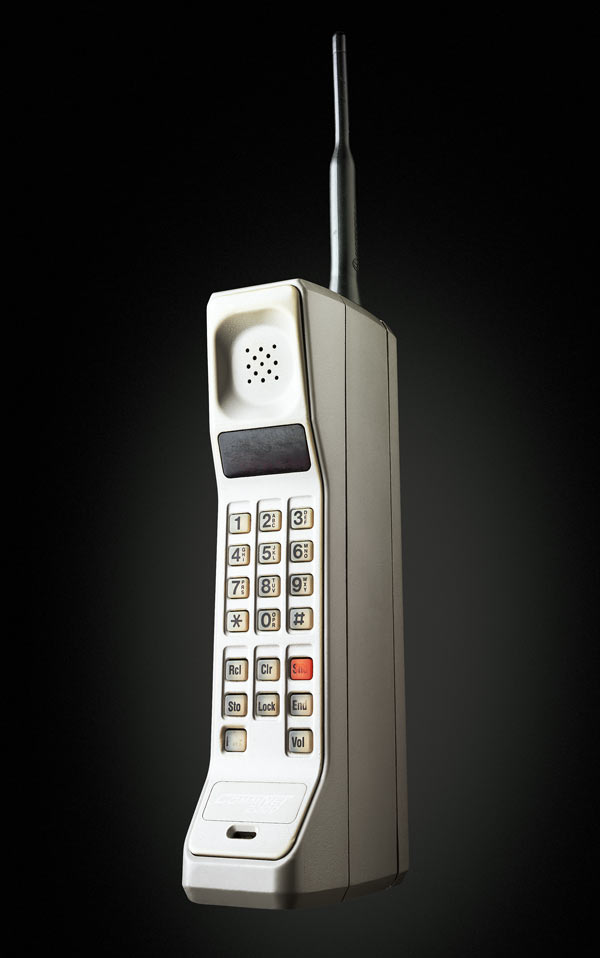
Released in the U.S. the first mobile phone


A mobile phone (also called mobile, cellular phone, cell phone or handphone) is an electronic device used for full duplex two-way radio telecommunications over a cellular network of base stations known as cell sites. Mobile phones differ from cordless telephones, which only offer telephone service within limited range through a single base station attached to a fixed land line, for example within a home or an office.
A mobile phone allows its user to make and receive telephone calls to and from the public telephone network which includes other mobiles and fixed line phones across the world. It does this by connecting to a cellular network owned by a mobile network operator. A key feature of the cellular network is that it enables seamless telephone calls even when the user is moving around wide areas via a process known as handoff or handover.
In addition to being a telephone, modern mobile phones also support many additional services, and accessories, such as SMS (or text) messages, email, Internet access, gaming, Bluetooth, infrared, camera, MMS messaging, MP3 player, radio and GPS. Low-end mobile phones are often referred to as feature phones, whereas high-end mobile phones that offer more advanced computing ability are referred to as smartphones.
The first handheld cellular phone was demonstrated by Martin Cooper of Motorola in 1973, using a handset weighing in at two kilos. In the year 1990, 12.4 million people worldwide had cellular subscriptions. By the end of 2009, only 20 years later, the number of mobile cellular subscriptions worldwide reached approximately 4.6 billion, 370 times the 1990 number, penetrating the developing economies and reaching the bottom of the economic pyramid.

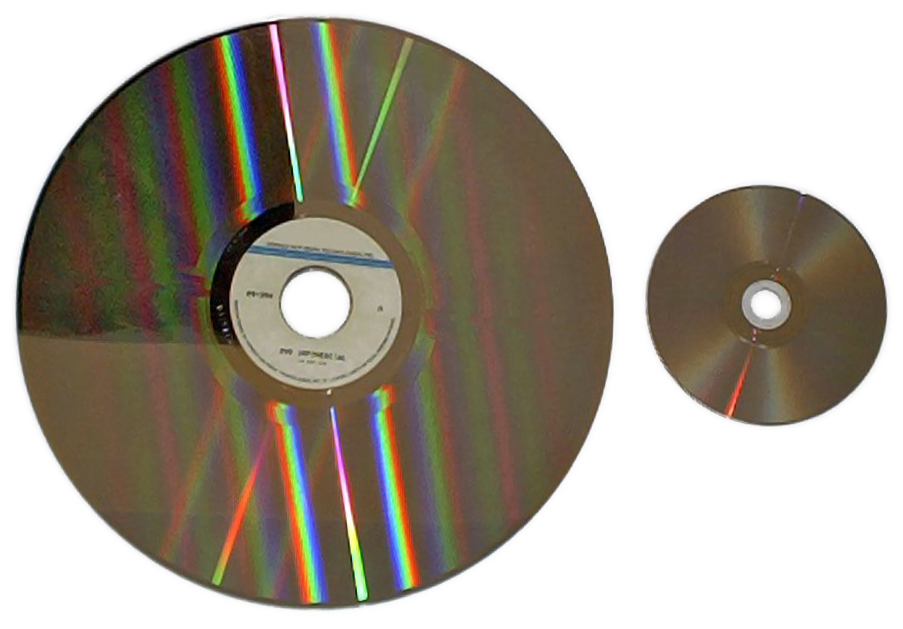
Laser discs are released revolutionizing the music industry


The LaserDisc (LD) is a home video disc format, and was the first commercial optical disc storage medium. Initially marketed as Discovision in 1978, the technology was licensed and sold as Reflective Optical Videodisc, Laser Videodisc, Laservision, Disco-Vision, DiscoVision, and MCA DiscoVision until Pioneer Electronics purchased the majority stake in the format and marketed it as LaserDisc in the mid to late 1980s.
While the format itself produced a consistently higher quality image than its rivals, the VHS and Betamax systems, it was poorly received in North America. In Europe and Australia, it remained largely an obscure format. It was, however, much more popular in Japan and in the more affluent regions of South East Asia, such as Hong Kong and Singapore. Laserdisc was the prevalent rental video medium in Hong Kong during the 1990s.
The technology and concepts provided with the Laserdisc would become the forerunner to Compact Discs and DVDs.